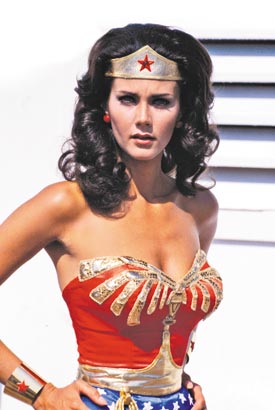
Is Wonder Woman your Sexual Archetype?

With Comic Con in full swing in downtown San Diego right now, I’m having flashbacks to Wonder Woman from my childhood. And since I’m in the sex field, not surprisingly this progressed to me reflecting on Wonder Woman as a sexual archetype. An archetype is a constellation of personality traits that form a recognizable character, such as the Mother, the Warrior, or the Teacher. If someone asked you to enact one of these roles, you’d have a good idea of what to do because they make sense to us.

I expand on this concept of archetypes to include sexual archetypes who can help us grow in our sexual identities. Do you like who you are in the bedroom? Do you express yourself authentically and fully in sexually encounters? Do you bring the best of you to sex? If not, a sexual archetype can be a tool for growth.

Due to the stigmas and discomfort we have around full sexual expression in the United States, sexual expression can often be stifled. If you have a fear of sexual rejection or fear of sexual judgment for being authentically sexually you (who grows up in this society and doesn’t?!), it can feel terrifying to try something different.

One way to break through your sexual blocks is to choose a sexual archetype with whom you identify. While we have archetype understandings of the Seductress or the Whore or the Goddess, I like to extend this to our cultural icons. What Hollywood star, movie or television character, or book persona exudes a sexual energy you’d like to embody? This is beyond role-playing because you are pulling out parts of yourself and developing comfort with them, with the intention of long-term integration.

It’s important to recognize the difference here between “performance” and “authentic” sexual expression. I’m not suggesting that you “perform porn star,” but that you tap into an energy of expression that resonates deeply with you, but has been blocked or never developed.  An archetype allows a big shift in perspective that offers permission to access and express new depths of your sexual being. So who do you want to be? If you're interested in learning more about the origins of the Wonder Woman character, check out my video from awhile ago about Wonder Woman.

~Dr. Jenn Gunsaullus, San Diego, CA -- Sociologist, Sexologist, Sexuality Speaker

(Photo of Lynda Carter as Wonder Woman from: http://bestofbothworldsaz.com/2011/03/12/wonder-woman-lynda-carter-an-arizona-beauty-2/)

Summer Sizzler Sex Newsletter

When you sign up for my newsletter mailing list, you definitely don't have to worry about having your email box slammed by me! That being said, since it's been a few months, I wanted to use the summer to help people catch up with what I've been up, and encourage them to use all the free videos and essays I have to support their growth in the realms of sex, intimacy, and relationships. I say, never stop learning about intimacy!

You can view the sex newsletter online HERE.

~Dr. Jenn Gunsaullus, San Diego, CA -- Sexologist, Sociologist, Sexuality Speaker

Safe First Date Tips - San Diego Living

I'm not a fear monger and don't like to put folks into fear mode. On the only hand, there are some simple smarts tips that are valuable to keep in mind on a first date, so that you stay safe and in control! I was interviewed on San Diego Living this week about safe first date tips and early red flags in dating.

~Dr. Jenn Gunsaullus, San Diego - Sexologist, Sociologist, Sexuality Speaker

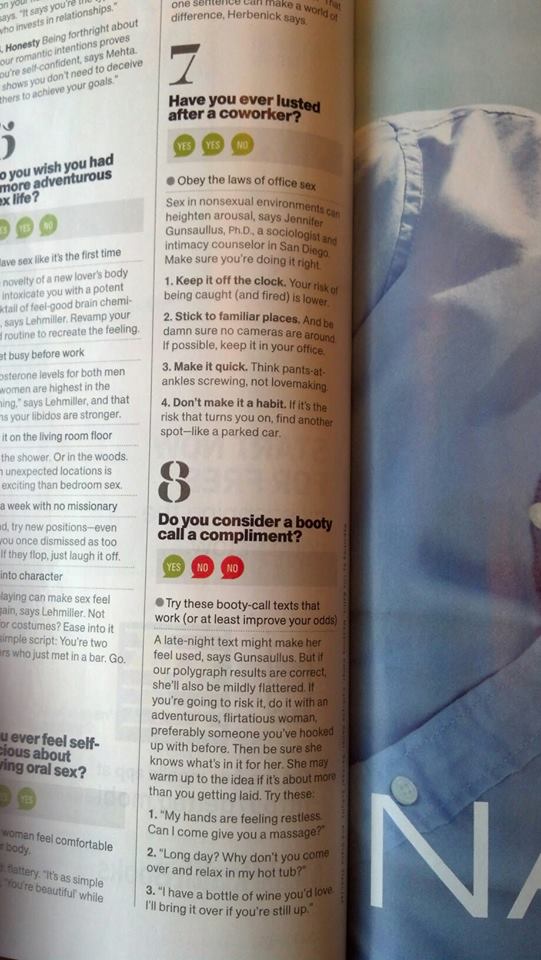
Sex in the Office & Booty Calls?

I was interviewed for the June issue of Men's Health Magazine about the topics of sex in the office and booty calls. These are not topics that I generally discuss in much depth, but I appreciated the opportunity to offer my two cents (which is often more about responsibility and respect, than titillation). My main perspective on sex in the office is to not be foolish about it, in terms of too much risk-taking, irritating your co-workers, or leaving a mess behind (no one likes to find someone else's pubic hairs on their desk in the morning). It is a fantasy for some and can be quite exciting because of its taboo and passionate nature. If this is the case, also consider seeking out other taboo settings (e.g., nature) where the risk of losing respect or your job are not on the line.

Regarding booty calls or the more relevant booty texts, I say be respectful. Remember that regardless of how much you say you only want sex, that is still another human being on the other end, with emotions, insecurities, and needs for connection (just like you). Sometimes booty texts are flattering and exciting, but in the long run they can lead to disappointment and feeling used. So appreciate and honor the person you're hooking up with and make sure their needs are being met too. And don't show up sloppy drunk - that's not fun sex for anyone!

~Dr. Jenn Gunsaullus, San Diego, CA -- Sociologist, Sexuality Speaker, and Sexologist

Why it Takes More Than Viagra

Last week I attended the annual AASECT conference (sexuality conference) in Miami, FL, and sat in on a two-hour workshop about sexual pharmacology. Did you know that the majority of viagra prescriptions are not refilled? I knew viagra-type medications did not work well for addressing women's desire and arousal, but didn't realize that perhaps many men were not satisfied as well.

It seems that some men pop a viagra and think that the added blood flow to their genitals will immediately take care of all their desire and arousal concerns. But without an emotional connection with their partner, or mental arousal, or some physical touching, it might not help. Sexuality is a full body experience.

The speakers shared an example of a man taking a viagra and then sitting down to play cards with his wife. He and his wife would occasionally peak under the table to see if something was happening. Unless they were playing strip poker, I don't think this qualifies as foreplay for most folks. And, as a side note, apparently viagra shouldn't be taken after a heavy meal, because its effectiveness is reduced. But think about that - who feels sexy after a heavy meal anyway?

~Dr. Jenn Gunsaullus, San Diego, CA -- Sociologist, Sexologist, Sexuality Speaker

Do you know HOW to be a good friend?

Are you the kind of friend, partner, or family member who others turn to, to share a story about how they felt ashamed? What I mean is, do you provide a sounding board of understanding and compassion when a loved one feels humilated, shamed, or embarrassed? Or does your reaction to their shame further accentuate their pain and discomfort? This can be a tough situation to know how to respond to properly, because we can feel very uncomfortable ourselves.

Consider this situation: a close friend or relationship partner calls to tell you about how their boss talked down to them during a meeting and they started crying. They tell you that they feel humilated by how their boss spoke to them in front of others and feel ashamed that they cried publicly. Brene Brown, in her wonderful book, The Gifts of Imperfection, writes about six ways that are NOT supportive responses. See if you find yourself in here:

1. The friend who hears the story and actually feels shame for you. She gasps and confirms how horrified you should be. Then there is awkward silence. Then you have to make her feel better.

2. The friend who responds with sympathy (I feel so sorry for you) rather than empathy (I get it, I feel with you, and I've been there)....

3. The friend who needs you to the pillar of worthiness and authenticity. She can't help because she's too disappointed in your imperfections. You've let her down.

4. The friend who is so uncomfortable with vulnerability that she scolds you: "How did you let this happen? What were you thinking?" Or she looks for someone to blame: "Who was that guy? We'll kick his ass."

5. The friend who is all about making it better and, out of her own discomfort, refuses to acknowledge that you can actually be 'crazy' and make terrible choices: "You're exaggerating. It's wasn't that bad. You rock. You're perfect. Everyone loves you."

6. The friend who confuses "connection" with the opportunity to one-up you. "That's nothing. Listen to what happened to me one time!"

Did you recogize yourself in any of these? Or did you think of a loved one with whom you shared a shameful story, only to have them respond in such a way that wasn't comforting? It's an act of courage when we share an embarrassing story, or when someone shares with us, but few of us learn how to provide a space of compassion and support. Brene Brown writes that speaking out about shameful experiences keeps them from growing and becoming even worse inside of us.

So what's the best way to respond? Listen deeply. Express empathy. Don't blame the person but also don't try to fix the situation. Make it clear that you are standing with them and let them talk. It may require heightened awareness to manage your response, but I believe it's worth the effort.

~Dr. Jenn Gunsaullus, San Diego, CA -- Sociologist, Sexologist, Sexuality & Relationship Speaker