When is it going to be enough?” a high school girl asks, choking back tears.
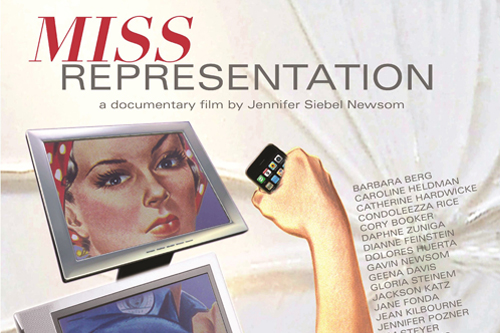 She’s referring to the incessant presence of negative body and beauty messages in the media, and the consequent impact on teen girls. What happens when girls and women repeatedly learn to self-objectify and that their primary value is in their appearance, youth, and sexuality? We end up with a society where only 17% of the seats in the House of Representatives are women, only 3% of clout positions in mainstream media are held by women, and 65% of girls and women have disordered eating behaviors.
This is the message of the 2011 documentary Miss Representation. From the Oprah channel to college campuses and community groups around the country, this documentary has been raising awareness and eyebrows since last fall. The overall theme is that by presenting messages about women in such limited ways, mainstream media contributes to the low numbers of women in leadership and influential positions. Many Hollywood stars, political leaders, and media experts shared their observations, including Condoleezza Rice, Geena Davis, Lisa Ling, Katie Couric, and Jennifer Pozner. This documentary included men in the dialogue as well, and addressed the impact of limited gender roles on women and men, such as socializing half our population to be emotionally illiterate.
How did things end up this way? My take-away from the movie regarding this negative state for women are three-fold. First, it is well known that media and ads are designed to make consumers feel anxious and insecure. This is what sells their products. The airbrushing and Photoshopping of female bodies creates impossible body standards. When this is continually combined with the importance of beauty, youth, and slenderness for women, you’re going to end up with a bunch of girls and women who feel insecure.
Second, most decision makers, whether in a media outlet or a political office, reflect and replicate the world they grew up in. They do this without questioning their assumptions about the way things are. However, when the majority of people in decision-making positions come from similar backgrounds, that means only a limited view of reality is presented in the mainstream media. With shocking statistics of how many positions of power are held by men, it makes sense why there are so few positive and powerful role models for girls.
Third, when you study the language and attitude used to describe and discuss male politicians versus female politicians, the trivializing of female politicians seems to belie an underlying discomfort with women in power. When a person feels that their power is being challenged, they often fight back, through bolstering themselves and trivializing their opponents. It would seem that empowered women are threatening to the status quo. You don’t have to look far to see how women in power are often critiqued or downright attacked for their appearance, clothing, or sexuality.
Miss Representation posits a compelling depiction of the state of affairs for women in leadership, and the context for girls learning whether they are worthy to be leaders. It’s a wake up call when we realize that one of the prominent “powerful” female stereotypes in movies, video games, etc., is the “fighting fuck toy.” The documentary concludes with a call to action to women, girls, and their supporters to use their consumer voice, voting voice, and personal voice to step up as leaders and recognize their internal strength. One young woman, 14-year old Julia Bluhm, has recently taken this to heart. She protested and collected 84,000 signatures to convince Seventeen Magazine to stop airbrushing and Photoshopping the shapes of their teen models. Next month, in Seventeen’s August issue, we will see their new look and presentation. If we speak up enough, we can make a difference.
(This was originally posted as part of the Love & Sex Blog at Pacific San Diego Magazine.)
~Dr. Jenn Gunsaullus, San Diego, CA -- Sexologist, Sexuality Speaker, College Sexual Health Speaker, Sex Therapist


 One of my biggest passions in the sexuality field is speaking about these topics in front of live audiences. I love having the opportunity to create safe and fun places to learn about sex and ourselves, despite potential embarassment by the audience and the taboo nature of frank sexual topics. To this end, I just created a new website which focuses on my work as a sexuality, sexual health, and safer sex speaker.