I'm happy to post a guest blog from my sister, Christine Gunsaullus! She's an engineer and does business development for her company. Since The 5 Love Languages is one of my most recommended books, I asked her to share her opinions from the business version of this book.
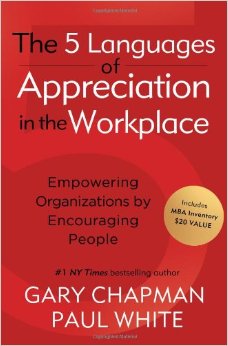
My Business Book Club recently read The 5 Languages of Appreciation in the Workplace. I won’t keep you in suspense — they are:
-
Words of Affirmation (examples: praise of accomplishments, affirmation of character, focus on personality).
-
Quality Time (examples: giving undivided attention, shared experiences).
-
Acts of Service (examples: helping with tasks, feeling that actions speak louder than words).
-
Tangible Gifts (examples: based on what the person values, the right gift for the right person).
-
Physical Touch (examples: hugs, high-fives, pat on the shoulder).
 One of these is the main way we each feel appreciated; the others work to a lesser degree or not at all. In the workplace, there is big value in determining the primary language of appreciation of your coworkers and employees. This is because employee retention is critical, as the cost to replace employees who leave is huge, both financially and emotionally.
One way to keep great employees is to make them feel appreciated so they don’t even think of leaving. It also feels good to you to show that you value their work in a way that’s meaningful to them. Trinkets at tradeshows (Tangible Gifts) didn’t have much meaning to me, but were like gold to coworkers who were pleased I brought back balsa airplanes to play with in the office.
If you don’t know which appreciation language is meaningful to coworkers, your efforts can backfire. For example, some folks cower from public attention, so verbal praise like giving them an award in front of a room full of people could feel torturous. They feel embarrassed and absolutely hate it, and will reconsider doing what got them the undesired attention. Instead, a private word (Words of Affirmation) with a bonus day of vacation (Tangible Gifts or Quality Time with family) could have much more personal value and mean the world to them.
The first step in determining the primary language of appreciation of your coworkers is realizing and accepting that what feels really good to you may not feel really good to everyone else. The second step is playing detective. Here’s a hint - often, we do for others what we most want for ourselves. So pay attention to what your coworkers give to and do for others, then give and do the same for them, and see what happens. Finally, note what they complain about, as that often highlights deep emotional hurts, and can clue you into giving them what they need the most.
I mentioned before that I’m a big hugger (Physical Touch), so I was curious how the book would approach touch in the workplace. They don’t recommend it as a primary means to show appreciation, as it’s challenging to translate appropriately. Our culture interprets physical touch as sexual, and therefore inappropriate to some degree. I was reminded to pay close attention to the body language of others, since I can’t know of past traumas, or if they have general discomfort with physical touch leaving them ultra-sensitive, so sometimes a handshake is just enough. Just Friday, a coworker expressed sadness that he was only getting a handshake when we said good-bye, so I gave Ed a big hug, and got a kiss on my cheek in return. And that felt really good to both of us. But my client, Jon, only wants a handshake, and I respect that, realizing that just because it’s one of my languages of appreciation, doesn’t mean that others feel the same.
Several people suggested that giving some praise or some small gift is better than nothing, but the book and I, from personal experience, disagree. Here are two examples:
-
At one firm, I was the “lucky” recipient of tickets to a Championship football game (Tangible Gifts). Sadly, I had absolutely no interest in going since my Eagles weren’t playing. I already had plans to relax and watch the game peripherally while hanging out with friends and doing work. But now I was tasked with an entire day entertaining a top client at the game. I can still feel the anger seething through me from this “gift” from my boss that I didn’t want.
-
This is a dating story, but still resonates. A friend routinely plans amazing excursions for the women he dates (Quality Time), then can’t understand why they don’t appreciate all the time and effort he put into it. He thinks all women suck, but can’t fathom that they may have a different primary appreciation language than he does, and perhaps even find it creepy that he puts so much effort into the first date when he doesn’t even know them.
Overall, I give the book 4 out of 5 stars. I was annoyed by the author selling his corporate training around the appreciation languages throughout the book. One whole chapter lists industry after industry, explaining ad nauseam how they were all helped by his work. The online test to determine your language of appreciation in the workplace is limited to one person per book sale, so I’m not actually sure what my primary language is. I also wish they gave more examples of the ramifications of lack of appreciation, as the contrast of failure, employee dissatisfaction and turnover would make a compelling argument for integrating this approach into the workplace.
Nonetheless, the authors liken the languages of appreciation in the workplace to vitamins and antibiotics, and I agree with the underlying value of this. They're not game changers, but instead supplements over the long run that keep you and your coworkers feeling good.
Thanks for you sharing your views, Christine!
~Dr. Jenn Gunsaullus, San Diego Sexologist, Sociologist, Sexuality Speaker