

When Consent Isn’t Enough: From my mother’s bedside to Epstein’s world, what consent misses about power
/I’ve been thinking about consent a lot this year, but in some new ways. In my work, I’ve long pushed back on simplified ideas like “No means no” and “Yes means yes” and tried to bring in the complexity of real human interaction. But what I didn’t expect was that caring for my dying mother would clarify what felt so wrong about Jeffrey Epstein’s world.
Consent is not just about permission, but about how power is used when someone is vulnerable.
My mom was diagnosed with terminal brain cancer in mid-November and lived a little less than three months more. My sister and I took care of her during those last few months, and in the final two weeks of her life, in more hands-on ways. There were many moments when we were doing things to her body that she couldn’t consent to.
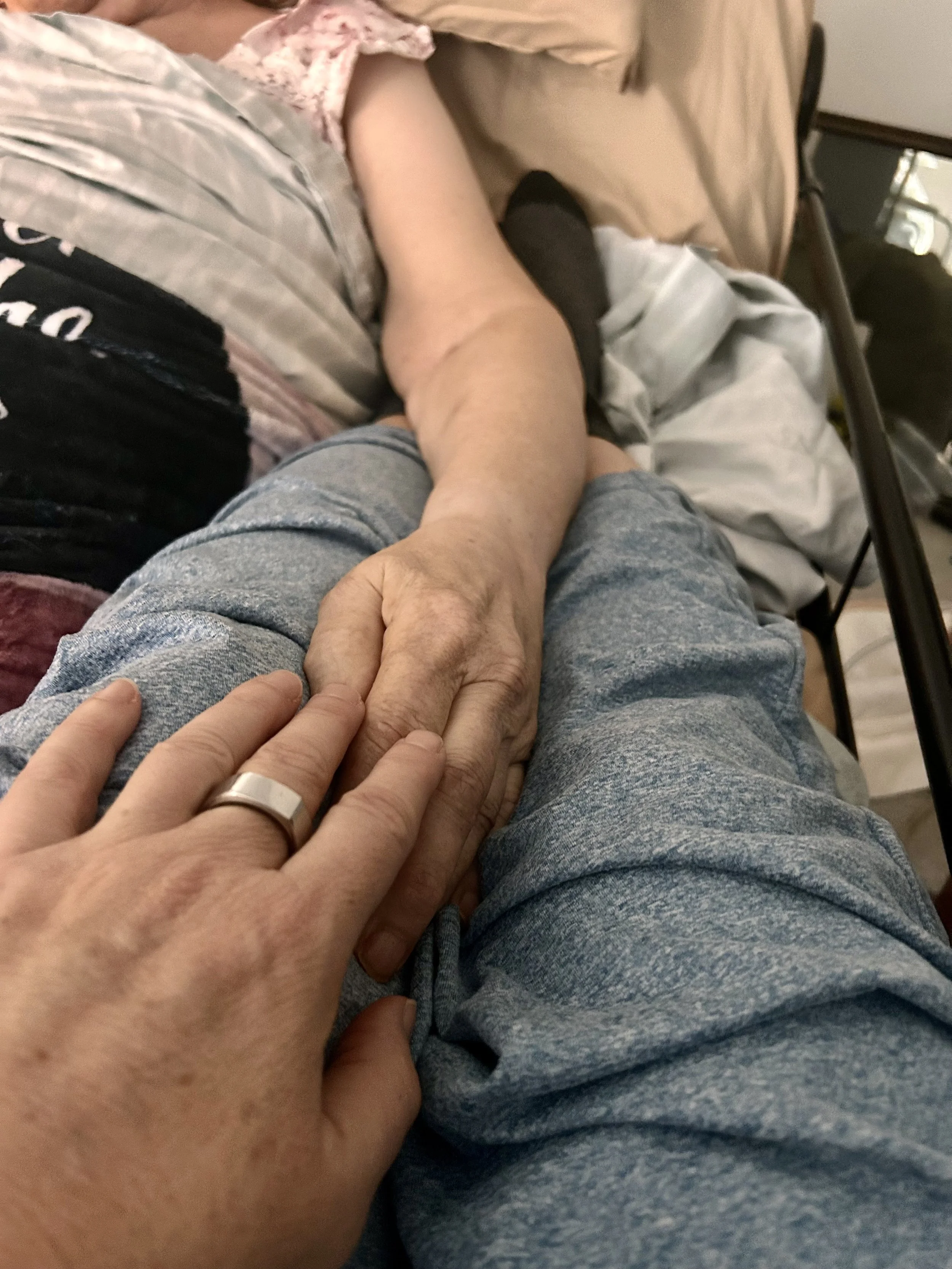
We were turning her, cleaning her, putting medicine in her mouth, wiping her chin, applying lotion to her hands and feet, rearranging her blankets and pillows. We were making decisions for her body because we were entrusted with her care, and not making them would have caused more discomfort or harm. When she couldn’t open her eyes or speak anymore, we asked questions while holding her hand.
“I see you just pulled your covers off. Squeeze my hand if that’s because you’re too warm.”
No movement.
“OK, you didn’t squeeze my hand, so you’re not hot. Squeeze my hand if you need to go to the bathroom.”
Squeeze.
“Got it. We’ll help you with that.”
We learned that as responding became more difficult for her, she wouldn’t say no or squeeze for a no, but she would say yes or squeeze for a yes.
After a couple of days, when she couldn’t squeeze our hands or communicate in any way, we started narrating all our actions.
“I’m going to swab your mouth a bit.”
“I’m going to shift your hospital bed now because I think it will help your coughing.”
“I’m sorry, we have to turn you on your side for a bit, and it might feel a little awkward. It’s so we can freshen things up. But I’ve got you, and Tine [my sister] will be as quick as possible.”
We kept talking to her, even though she couldn’t respond, even though we didn’t know if she could feel the movements or hear us.
It didn’t seem like we could be too communicative with someone who is unresponsive but might still be aware of bodily sensations, movement, and sound. It didn’t seem like we could be too compassionate.
Because even when she couldn’t answer, her body was still hers. Her experience still mattered.
That experience clarified a key concept of my “compassionate consent” approach that I use when speaking to college students: Consent is deeply tied to how we hold power when someone is vulnerable. And even if we don’t recognize a power differential, consent is deeply tied to actually caring about the fellow human in front of us.
I remember a friend about ten years ago sharing something similar with me about her toddler who had a vulva infection. She said, “I have to take care of her and put cream on her, but she can’t really consent.” And she felt uncomfortable about that.
That stayed with me because it points to something deeper than rules or checking a box. It points to what happens when we are touching another human body in the context of unequal power. Caring for my mom and caring for her daughter raises the same question: Are we conscious and respectful of our power when another body is vulnerable?
This is at the heart of caregiving, and it is also at the heart of what we saw with Jeffrey Epstein and the network of powerful men who seemed to flock to him. In all of these situations, one person is touching another’s body while holding far more power.
When we talk about Epstein, many people focus on the criminal abuse of minors, which is clear and horrific. But there’s another layer that is worth looking at if we are trying to understand how power operates in more subtle ways.

After his 2008 conviction, reporting suggests that he shifted much of his attention to young adult women who were technically “of age,” many in their late teens or early twenties.
This is where our over-simplified consent framework feels inadequate. Because yes, these women could legally consent. And at the same time, they were interacting with men who had vastly more wealth, status, experience, and influence.
Many young women have been socialized to be accommodating, to be liked, to interpret attention as opportunity, and to tolerate discomfort as part of the exchange. A notable number of young women in Epstein’s orbit were from Eastern European countries, some seeking education or other opportunities abroad.
When those dynamics met significant power differences, and specifically power dynamics with men who liked having access to accommodating young women with less power, it led to exploitation.
So instead of only asking, “Did she consent?” or “Why didn’t she say no?” it becomes important to also ask what made it difficult, costly, or unrealistic for her to say no. Because the absence of a no doesn’t necessarily reflect comfort; it can be an adaptation strategy. When resistance carries a cost, silence can become a way of navigating that reality.
It’s also important to ask why someone would seek out sexual situations with such unequal power dynamics in the first place. There are likely multiple layers—male socialization, entitlement to pleasure, lack of empathy, even the appeal of transgression—but what stands out most is that the imbalance itself seemed to be part of the draw, especially for Epstein himself.
I also think it’s important to look at what the sexual dynamic itself was organized around. In a mutual sexual experience, there is some level of shared attention: curiosity about the other person and the recognition that they have a full experience of their own, shaped by emotions, needs, insecurities, and desires that may be quite different from our own. And it includes the belief that the experiences of all the people in the sexual encounter matter.
In the patterns described around Epstein, the focus appeared to be much narrower. The interactions revolved around what the person with power wanted to feel, access, or experience. The young women existed in that situation to support that outcome. That created a very different kind of encounter, even if, on the surface, there was agreement.
One of the most striking differences between what I experienced with my mom and what we see in cases like Epstein’s is the orientation to power.
With my mom, the power we had over her body felt heavy. It came with responsibility, care, and a constant awareness that we were making decisions she could not fully participate in. We went slowly, explained, and paid attention to small reactions. We tried to reduce discomfort wherever we could.
We were not “getting” something from those interactions or taking something from her. Our attention stayed on what we thought it felt like to be her in each moment.
In Epstein’s world, the power created access, and it allowed someone’s sexual preferences to take priority without much friction. The absence of resistance, or the appearance of agreement, was enough. Who the interaction was for was very clear.

There was a moment, four days before my mom passed, that brought these concepts into sharp focus for me. It was a Wednesday morning around 8:15am.
She hadn’t spoken in several days. She had stopped being able to swallow the day before. We didn’t know if she had any conscious awareness.
My sister was wiping her mouth and, as always, explaining what she was doing.
“I’m going to wipe the right side of your mouth and chin because you have some liquid on there. OK, I hope that feels better?”
My mom whispered, “Yes.”
My sister was stunned. “Did you just say yes? Because it feels better?”
“Yes,” my mom said again.
This small moment felt enormous.
Because our mother was suddenly back. And because it confirmed something we had been operating from intuitively: Even when someone cannot consent, they are still having an experience. They may still register comfort or discomfort. They may still feel the difference between being handled and being cared for.
On this Wednesday, my mom had multiple bursts of what’s called terminal lucidity, a brief return of clarity near the end of life. At one point that afternoon, when she was awake for about ten minutes, I asked her if she liked it when I climbed into bed next to her to spend time lying together. She gave a quiet “yes.”
The respect and kindness my sister and I, along with our favorite night aides, brought to her—our nuanced and communicative care, and our dedication to staying emotionally connected to her—mattered. We got the gift of knowing this was true through the final gift of her conscious presence.
This has added nuance to how I think about consent, and how we talk about it more broadly.
We tend to frame it as a clear yes or no, present or absent. It includes whether someone agrees, of course. But in reality, it is shaped by power, presence, and care:
Power: who has it and how it’s used.
Presence: whether the person with more power is paying attention to the other’s experience.
Care: whether the other’s humanity matters as much as our own.
We have built a cultural understanding of consent that focuses heavily on permission, and not enough on relationship. But a core aspect of consent is our willingness to see the humanity in every other human and recognize that they are not us, but they matter as much as we do.
Desire can be shaped by status, access, or validation. But can we stay connected to another person’s humanity when we want something from them? Without that, consent can be present on paper but disconnected in practice.
Caring for my mom gave me a lived experience of what it means to hold power carefully.
That experience now lives in me when I see cases like Epstein’s, and also the excuses used by the men who raped Gisèle Pelicot in France (if you’re not familiar with this horrifying case, here’s more information).
If we want a more meaningful, educational, and protective understanding of consent, we need to expand the conversation. The clearest difference I can articulate now is between those who include the other person when organizing their choices, and those who organize their choices only around their own needs. And too often, the bodies and lived experiences of women are treated as secondary in that equation.
What my mother showed me in her final days is that regardless of whether someone can verbally consent or not, we are still responsible for how we hold power over another person’s experience.
And how we hold that power reveals who we are.
~Dr. Jenn Gunsaullus — Sociologist, Intimacy Speaker, Relationship Coach, Author