
"I Don't Want Sex" - What Women May Mean When They Say This

(Note to Den reader: This article was specifically written for the male reader at The Good Men Project, a place for men to read, speak, and debate what it means to be a "good man" in the 21st Century.)

In my private practice with couples, I often translate female sex-speak to male sex-speak, particularly when a woman says, “I don’t want sex.” What does this mean to a man? And what are some possible reasons why the woman is saying that?

Despite the overlapping nature of our sexual needs and desires, men and women have different experiences of sex. Whether the differences are innate, socialized, or a combination of both, either way, ignoring these variations creates huge chasms in relationships. Women don’t mean to be vague or difficult, and they’re not trying to confuse men or set up for “failure.” Clear sexual communication is really hard for everyone and the vocabulary for it can feel like a foreign language. Below are five phrases many women often say, along with some interpretations. I offer one of many translations here to bridge this sexual gender gap.

1. “I’m just not in the mood.”

What Men Fear

She’s not attracted to me anymore. I’m not desirable. I feel powerless, and it isn’t fair that this keeps happening. I resent her for playing the role of gatekeeper.

Translation

As cliché as this “excuse” is, there are many reasons why a woman might say this. It might have something to do with you or it may not! Desire requires a balance of increasing excitement and reducing inhibitions. Resentment, hurt feelings, feeling overwhelmed, and even bad breath can all increase inhibitions. In long-term relationships, women’s physiological horniness may decline, so it’s easy to not want sex because her body doesn’t crave it.

Sex may also be less of a priority for her because her needs for intimacy and connection are now being met in other ways. Her mind and body don’t kick in like yours do with a deep need for sexual connection. Having less desire may put her in the gatekeeper role, but that’s a role most women play with guilt not power.

So what can you do? Prime her pump! This means finding out specifically what makes her shut off her multi-tasking brain, and feel present in her body to receive pleasure through touch. What makes her feel safe and nurtured by you? Priming the pump could be a day-long process, so be up for the challenge. It gets easier the more you learn the nuances of this dance.

2. “Stop. I’m not going to orgasm this time.”

What Men Fear

I’m not doing a good job turning you on and pleasing you. I’m a terrible lover. If you don’t orgasm, you can’t enjoy sex.

Translation

Sometimes, even the perfect alignment of the sun, moon, and stars can’t get a woman to orgasm. Sometimes she’s just tired and can’t concentrate enough to orgasm. Physical factors could also be at play, like where she is in her menstrual/ovulation cycle and whether she’s going through menopause, the amount of rest she’s getting and the time of day of the intimacy involved. Even poor nutrition can have an effect on her sex drive. Additionally, emotional components like her stress level, priority distractions, and sense of safety, whether she’s feeling pressure from you and whether there’s relationship distress—all of those things can kill orgasms.

A really important insight for men into women is that pleasure does not necessarily equal orgasm. Clearly orgasm is pleasurable, but there are so many aspects of sex that are pleasurable, like skin-to-skin contact, emotional closeness, playfulness, and giving pleasure....

Read the next three translations and the entire article published at The Good Men Project here: Female Translation of "I Don't Want Sex."

~Dr. Jenn Gunsaullus, San Diego, CA -- Sexologist, Sociologist, Sexuality Speaker
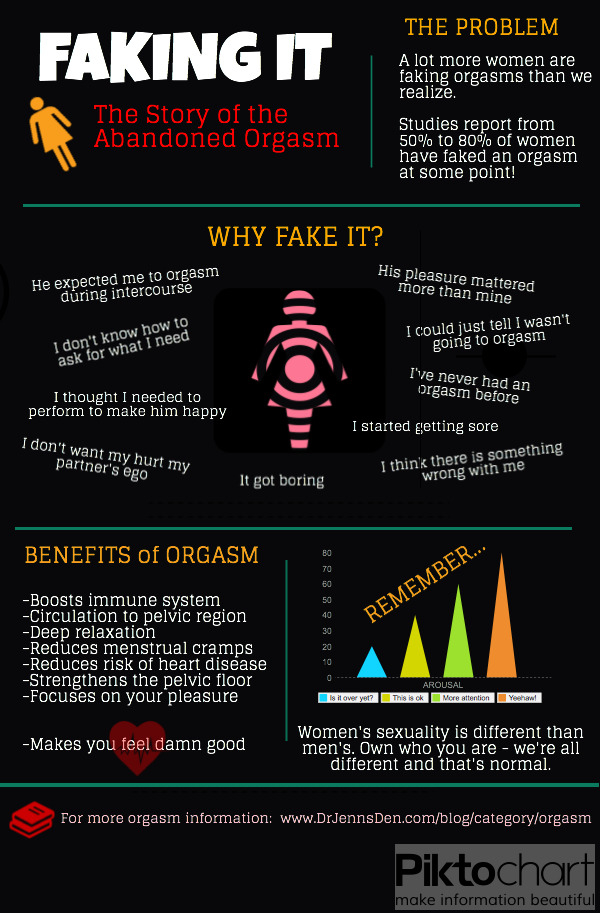
Faking It! Female Orgasm Infographic

I'm excited to present here my first infographic, created with the help of colleague Christy Stevens. I hope this infographic about orgasm, female sexuality, and faking it inspires you to learn more about orgasms! Click here for lots of great orgasm resources to learn from.

~Dr. Jenn Gunsaullus, San Diego, CA -- Sexologist, Sexuality Speaker, Sociologist

Communicate Better AND Reduce Stress?

The advice I offer in the interview below is good year round, but during the holdays we can get caught up in the stress and forget about the most important present of all -- slowing down and being present with our loved ones. I was interviewed on Channel 6 Wake Up San Diego this morning about some simple yet important ideas to connect more deeply. These ideas are all based in research around communication or connection.

~Dr. Jenn Gunsaullus, San Diego - Sexologist, Sociologist, Sexuality Speaker

Opening the Tiny Hurt Locker - Why Men Need to "Hurt" Their Partners

I am a new writer for the Relationships, Love + Sex section of the Good Men Project. The Good Men Project's tagline says it all: The conversation no one else is having. I like to think I have a lot of conversations with folks daily about things that don't usually get talked about. So I'm excited to bring my perspectives on sex, intimacy, relationships, gender, and power to the GMP table. Below is my first article with them published today:

It’s necessary to hurt your relationship partner. No, seriously. Think about it this way: it is inevitable that when you come together with another person with different experiences, expectations, beliefs, goals and needs, you will sometimes disagree and disappoint your partner. That can hurt both you and your partner emotionally. But sometimes, that’s necessary.  For example, your partner wants to spend the afternoon shopping with you. You agree, although you’d rather poke your eye out with a sharp stick. On Friday night, you assume you’re hanging out with your partner, but then learn she chose to spend time with her friends instead. And the list goes on. These things may seem minor, but they add up over time if you don’t discuss them honestly because they are based on a false compromise.

Some men are afraid to hurt their female partners. I see this in my private practice all the time. Kids are often told by their dads: “don’t ever hurt a woman.” That’s great advice for raising men who respect women.  And it’s great to acknowledge that many men do have the power to physically hurt women. Unfortunately, kids don’t have the brain development to grasp the nuanced meaning of social issues. Therefore, by adulthood, this well-intentioned guideline becomes a black and white principle for many men, even around complex emotional situations. If men want to talk about anything that could hurt their partner, they don’t. This is where real problems emerge.

When you don’t express your thoughts or opinions, bad shit starts to happen. Your unspoken truths turn into unspoken resentments. I’ve observed that when people have negative feelings and their feelings go ignored or unprocessed, people behave badly. So in the long run, your initial silence ends up hurting your partner even more. This silence is based partially on fear and guilt: fear of confrontation, fear of feeling horrible for hurting the woman you love, and the guilt over making her cry. That fear and guilt come from a noble and responsible belief system. But it’s imperative to recognize the difference between “small hurts” and “big hurts.” Small hurts, handled responsibly, can avoid big hurts.

Easier said than done though. Let’s say you disagree with your partner’s decision to discipline the kids, but keep your opinions to yourself and become passive aggressive with your resentment. Later on, when your partner is disappointed by your attitude or your lack of support, you avoid taking any responsibility at all, or even lash out because you didn’t feel like you had a choice. However, you did have a choice. You always do.

It all comes down to learning how to acknowledge and sit with the discomfort of hurting your partner. This means building resiliency, including establishing trust in yourself that you can handle your negative feelings, manage seeing disappointment in your partner, and know that you’ll still be loved.  It means remembering that you are a good man. It means choosing to acknowledge your discomfort and staying present with it. This is resiliency.

Where do you feel the discomfort inside your body? Is it a gnawing in your gut? A sinking feeling in your stomach? An ache in your chest? Sometimes, clients describe a tightness in their throat when they are afraid to say something. These sensations are so uncomfortable. Most of us probably learned to run, numb or distract ourselves, withdrawing into video games or the Internet, alcohol or eating. Sometimes, we even lash out in anger. But staying present with the pain and facing the discomfort head-on allows for more conscious and authentic interactions that are critical for relationships to thrive.

It is natural, normal, and even healthy to have disagreements. This is all part of the negotiation required to merge two lives. When you choose to acknowledge and negotiate the small hurts honestly and responsibly, you live more from love than fear.

Conscious conversations like this one must include the participation of both partners. It is tough when it’s one-sided, and this could happen if you start speaking your truth in new ways. Over time though, you can model responsible communication and claim ownership of difficult emotions, co-building a relationship where both partners are resilient enough to handle disappointment and move on. If one or both of you lack the skills to communicate in this way, a counselor or therapist, or even a good relationship book, can offer you tools.

I’m reminded of my mother’s framed needlepoint that hung on our living room wall. It read, “A stitch in time saves nine.” The more adept you become at addressing small hurts, the less likely you will need to address the big ones later on.

(Image Credit: Flickr/-Rodrigo Vargas-)

~Dr. Jenn Gunsaullus, San Diego, CA -- Sexologist, Sociologist, Sexuality Speaker

Dancing 12 Foot Bra for Breast Health & Breast Cancer Awareness

WARNING: Dancing 12 foot bra, ridiculous singing, and disturbing statistics! Something to make you think (or cringe or laugh) this October/November for Breast Cancer Awareness Month. Also ideas to prioritize your breast health and your "breast" friends.

~Dr. Jenn Gunsaullus, San Diego, CA -- Sexologist, Sociologist, Sexuality Speaker