Communicate Better AND Reduce Stress?

The advice I offer in the interview below is good year round, but during the holdays we can get caught up in the stress and forget about the most important present of all -- slowing down and being present with our loved ones. I was interviewed on Channel 6 Wake Up San Diego this morning about some simple yet important ideas to connect more deeply. These ideas are all based in research around communication or connection.

~Dr. Jenn Gunsaullus, San Diego - Sexologist, Sociologist, Sexuality Speaker

Opening the Tiny Hurt Locker - Why Men Need to "Hurt" Their Partners

I am a new writer for the Relationships, Love + Sex section of the Good Men Project. The Good Men Project's tagline says it all: The conversation no one else is having. I like to think I have a lot of conversations with folks daily about things that don't usually get talked about. So I'm excited to bring my perspectives on sex, intimacy, relationships, gender, and power to the GMP table. Below is my first article with them published today:

It’s necessary to hurt your relationship partner. No, seriously. Think about it this way: it is inevitable that when you come together with another person with different experiences, expectations, beliefs, goals and needs, you will sometimes disagree and disappoint your partner. That can hurt both you and your partner emotionally. But sometimes, that’s necessary.  For example, your partner wants to spend the afternoon shopping with you. You agree, although you’d rather poke your eye out with a sharp stick. On Friday night, you assume you’re hanging out with your partner, but then learn she chose to spend time with her friends instead. And the list goes on. These things may seem minor, but they add up over time if you don’t discuss them honestly because they are based on a false compromise.

Some men are afraid to hurt their female partners. I see this in my private practice all the time. Kids are often told by their dads: “don’t ever hurt a woman.” That’s great advice for raising men who respect women.  And it’s great to acknowledge that many men do have the power to physically hurt women. Unfortunately, kids don’t have the brain development to grasp the nuanced meaning of social issues. Therefore, by adulthood, this well-intentioned guideline becomes a black and white principle for many men, even around complex emotional situations. If men want to talk about anything that could hurt their partner, they don’t. This is where real problems emerge.

When you don’t express your thoughts or opinions, bad shit starts to happen. Your unspoken truths turn into unspoken resentments. I’ve observed that when people have negative feelings and their feelings go ignored or unprocessed, people behave badly. So in the long run, your initial silence ends up hurting your partner even more. This silence is based partially on fear and guilt: fear of confrontation, fear of feeling horrible for hurting the woman you love, and the guilt over making her cry. That fear and guilt come from a noble and responsible belief system. But it’s imperative to recognize the difference between “small hurts” and “big hurts.” Small hurts, handled responsibly, can avoid big hurts.

Easier said than done though. Let’s say you disagree with your partner’s decision to discipline the kids, but keep your opinions to yourself and become passive aggressive with your resentment. Later on, when your partner is disappointed by your attitude or your lack of support, you avoid taking any responsibility at all, or even lash out because you didn’t feel like you had a choice. However, you did have a choice. You always do.

It all comes down to learning how to acknowledge and sit with the discomfort of hurting your partner. This means building resiliency, including establishing trust in yourself that you can handle your negative feelings, manage seeing disappointment in your partner, and know that you’ll still be loved.  It means remembering that you are a good man. It means choosing to acknowledge your discomfort and staying present with it. This is resiliency.

Where do you feel the discomfort inside your body? Is it a gnawing in your gut? A sinking feeling in your stomach? An ache in your chest? Sometimes, clients describe a tightness in their throat when they are afraid to say something. These sensations are so uncomfortable. Most of us probably learned to run, numb or distract ourselves, withdrawing into video games or the Internet, alcohol or eating. Sometimes, we even lash out in anger. But staying present with the pain and facing the discomfort head-on allows for more conscious and authentic interactions that are critical for relationships to thrive.

It is natural, normal, and even healthy to have disagreements. This is all part of the negotiation required to merge two lives. When you choose to acknowledge and negotiate the small hurts honestly and responsibly, you live more from love than fear.

Conscious conversations like this one must include the participation of both partners. It is tough when it’s one-sided, and this could happen if you start speaking your truth in new ways. Over time though, you can model responsible communication and claim ownership of difficult emotions, co-building a relationship where both partners are resilient enough to handle disappointment and move on. If one or both of you lack the skills to communicate in this way, a counselor or therapist, or even a good relationship book, can offer you tools.

I’m reminded of my mother’s framed needlepoint that hung on our living room wall. It read, “A stitch in time saves nine.” The more adept you become at addressing small hurts, the less likely you will need to address the big ones later on.

(Image Credit: Flickr/-Rodrigo Vargas-)

~Dr. Jenn Gunsaullus, San Diego, CA -- Sexologist, Sociologist, Sexuality Speaker

Easy Sex Tips to Try Now...on Wake Up San Diego (Ch. 6)

Forget the complicated Kama Sutra that justs sits on your shelf and overwhelms you! Here are some simple tips you can do right away and continually to keep you more intimately connected to your partner. We focused more on fun than educational content in this piece, but hopefully you can laugh along with us :)

~Dr. Jenn Gunsaullus, San Diego -- Sexologist, Sociologist, Sexuality Speaker

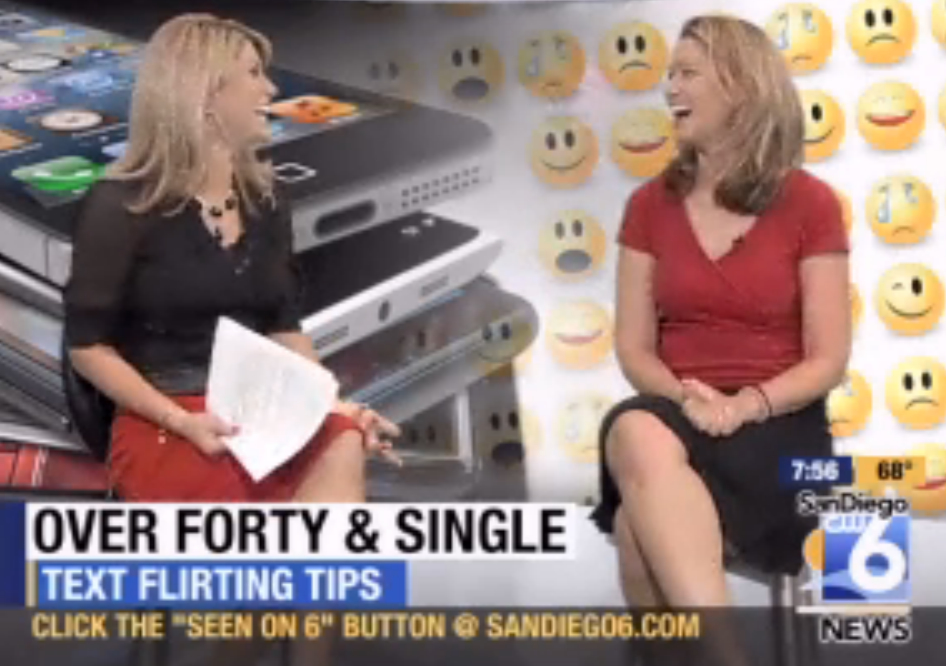
How to Flirt Through Texts...and How NOT To (On Channel 6 News)

Flirting through texting is a good thing - seriously. I don't think that technology today is interfering with all real communication, and flirting is a good example of something that can be facilitated and potentially enhanced through the media of texting. I spoke about the Dos and Don'ts of flirting through texting today, specifically for folks who are over 40 years old, on Channel 6's Wake Up San Diego. Check out the video posted below, and I've included some other thoughts below I didn't have time to articulate on the news.


I see 3 different categories of flirting through texting: Playful/teasing, romantic, and sexual. The playful version is like the teasing we did as teenagers by our lockers in high school (or was that just me?). For example, if your object of interest is reading poetry, make a cute jab about them "being a brooding poet," and include a winking emoticon so they know you're kidding. I just watched a young woman and man do this type of teasing bantering in a cafe recently. It was ridiculously transparent to the point of annoyance (to me, at least). But doing through texting, where no one else has to witness, is a good idea!

The romantic version of flirting through texting can be incredibly sweet, and the type of texts that girlfriends swoon over and share with friends. This is your chance to offer a genuine compliment - a funny memory from a recent date, a feature you love about them, or even a quote that expresses how your feel. Also, remembering to ask about something important about their day, such as a big meeting or their child's doctor appointment, can feel very nurturing on the receiving end.

And finally - sexting! This definitely gets the most attention and needs to be done with care. Two "don'ts" off the bat: Don't send naked photos and don't text late at night when drunk. I hear about frequent regrets in these areas. But DO plant the seeds for sexual banter, such as "I just got out of the shower," and let the intensity slowly build.

Don't use texting for long conversations better left to phone or email, but also don't write really short responses if you're interested in the other person and they are writing in more depth. In addition, if most of your relationship is unfolding via text and not in person, your date may not be willing to commit and you might want to move on. Do YOU have any flirting through texting lessons you learned the hard way?

~Dr. Jenn Gunsaullus -- San Diego, Sexologist, Sociologist, Sexuality Speaker

Safe First Date Tips - San Diego Living

I'm not a fear monger and don't like to put folks into fear mode. On the only hand, there are some simple smarts tips that are valuable to keep in mind on a first date, so that you stay safe and in control! I was interviewed on San Diego Living this week about safe first date tips and early red flags in dating.

~Dr. Jenn Gunsaullus, San Diego - Sexologist, Sociologist, Sexuality Speaker

Sex in the Office & Booty Calls?

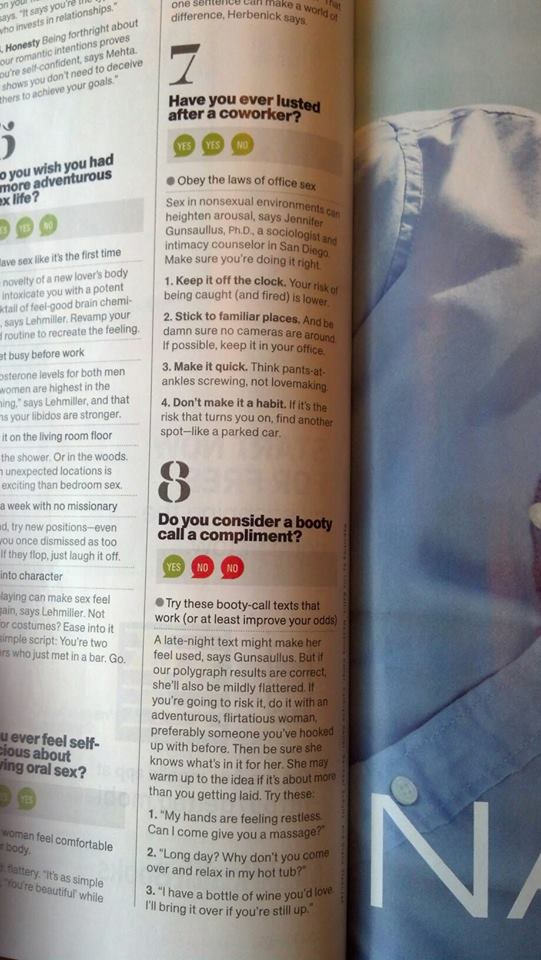
I was interviewed for the June issue of Men's Health Magazine about the topics of sex in the office and booty calls. These are not topics that I generally discuss in much depth, but I appreciated the opportunity to offer my two cents (which is often more about responsibility and respect, than titillation). My main perspective on sex in the office is to not be foolish about it, in terms of too much risk-taking, irritating your co-workers, or leaving a mess behind (no one likes to find someone else's pubic hairs on their desk in the morning). It is a fantasy for some and can be quite exciting because of its taboo and passionate nature. If this is the case, also consider seeking out other taboo settings (e.g., nature) where the risk of losing respect or your job are not on the line.

Regarding booty calls or the more relevant booty texts, I say be respectful. Remember that regardless of how much you say you only want sex, that is still another human being on the other end, with emotions, insecurities, and needs for connection (just like you). Sometimes booty texts are flattering and exciting, but in the long run they can lead to disappointment and feeling used. So appreciate and honor the person you're hooking up with and make sure their needs are being met too. And don't show up sloppy drunk - that's not fun sex for anyone!

~Dr. Jenn Gunsaullus, San Diego, CA -- Sociologist, Sexuality Speaker, and Sexologist